Southwest Washington gets roughly 45 to 55 inches of rain per year depending on your location in Cowlitz or Clark County — nearly four times the average for cities like Phoenix. That level of persistent moisture means your driveway material choice matters more here than in drier climates. What holds up in California can fail within a few years in the Pacific Northwest if the sub-base, drainage, and material selection aren’t calibrated for the conditions. Brynion Excavation handles driveway work throughout Kelso and Longview, and the question we hear most often comes down to one comparison: concrete or asphalt?
Upfront Cost: Asphalt Is Cheaper to Start, Concrete Earns It Back
For a standard two-car residential driveway of 600 to 800 square feet, current installed pricing in Southwest Washington:
- Asphalt: $7 to $13 per square foot installed, including base prep and compaction. A 700-square-foot driveway runs approximately $4,900 to $9,100.
- Concrete: $10 to $18 per square foot installed for a standard broom-finish slab with proper reinforcement. The same driveway runs approximately $7,000 to $12,600.
The upfront gap is real — concrete typically costs 30 to 50 percent more. But asphalt requires sealcoating every 3 to 5 years at $300 to $800 per application, and crack repair adds up. Concrete needs far less routine maintenance, though individual repairs cost more ($3 to $25 per square foot). Over a 25-to-30-year horizon, total ownership costs converge, and concrete frequently comes out ahead for long-term owners.
Lifespan in a Wet Climate
National averages for driveway lifespan: 15 to 20 years for asphalt, 25 to 40 years for concrete. The Pacific Northwest compresses the asphalt end of that range.
Asphalt in the PNW: Asphalt’s flexibility is an advantage in cold climates with freeze-thaw cycles — it can absorb minor ground movement without cracking like a rigid slab. However, the region’s abundant rainfall accelerates asphalt oxidation, and the clay-heavy soils common in the Cowlitz River valley can shift unevenly under a driveway, creating low spots where water pools and softens the binder. Without consistent sealcoating and rapid crack response, asphalt driveways in this climate typically hit their replacement window at 12 to 18 years rather than the 20-year textbook figure.
Concrete in the PNW: Concrete’s main vulnerability in wet climates is freeze-thaw spalling — moisture infiltrates surface pores, freezes, expands, and causes the top layer to chip and pit. The Kelso/Longview area sits at 100 to 200 feet elevation, with winters hovering around 30 to 38°F — cold enough for occasional freezing but far less severe than higher elevations. Air-entrained concrete mixes, which trap tiny air bubbles to relieve freeze-thaw expansion pressure, are standard practice for exterior slabs in Western Washington and significantly extend slab life. A properly installed concrete driveway with adequate drainage can realistically reach 30 years or more in Southwest Washington.
The wildcard for both materials is sub-base preparation. In Cowlitz County’s river-deposit soils — silty loams, gravelly alluvium, pockets of expansive clay — the quality of the gravel base and compaction under the driveway matters more than which surface material you choose. A concrete slab over a poorly prepared base will crack within five years. An asphalt driveway over a solid, well-draining 6-inch crushed rock base can perform well for 15 to 20 years with proper maintenance.
Drainage: The Priority That Outweighs Material Choice
Both materials require proper drainage design, but the consequences of getting it wrong accelerate faster here than in drier climates. A minimum 1 to 2 percent cross-slope drains surface water away from the structure and off driveway edges. For driveways on sloped lots (common in the hillier parts of Cowlitz County), drainage swales or channel drains at the base of the driveway prevent water from backing up against a foundation or garage slab.
Concrete has one advantage here: its rigid surface doesn’t develop ruts or depressions the way softened asphalt can. Asphalt that has lost binder to oxidation tracks tire marks and creates low points where water sits — those low points accelerate base failure significantly. Our grading services team designs driveway sub-base drainage as part of every installation, establishing the correct slope and ensuring surface water has a clear path away from your home.
Head-to-Head: Concrete vs Asphalt for the Pacific Northwest
| Factor | Asphalt | Concrete |
|---|---|---|
| Installed cost (per sq ft) | $7–$13 | $10–$18 |
| Realistic PNW lifespan | 12–18 years | 25–35 years |
| Freeze-thaw performance | Better (flexible) | Good with air-entrained mix |
| Rain/wet durability | Moderate (sealcoating required) | Good (lower surface permeability) |
| Annual maintenance cost | $150–$300 | $50–$150 |
| Repair difficulty | Easy (patch or overlay) | Harder (section replacement) |
| Curing time before use | 1–3 days | 7 days (28 for full cure) |
When Asphalt Makes More Sense
Asphalt makes sense when the upfront budget gap matters, when you plan to sell within 10 years, or when you have a long rural driveway where lower per-foot cost adds up significantly. Many properties in Cowlitz and Lewis Counties have 200- to 500-foot driveways where the cost difference reaches several thousand dollars. Asphalt can also be milled and overlaid rather than fully replaced when the base remains sound.
See our Driveway Repair page for repair and overlay options if your existing asphalt surface is showing wear but still has a serviceable base.
When Concrete Makes More Sense
Concrete is the better investment for homeowners staying 20 or more years. Lower lifetime maintenance cost and a longer replacement cycle make it more economical over the full horizon. It also outperforms asphalt under heavy static loads like RVs and work trucks, where its 3,500-to-4,000 psi compressive strength holds up better than asphalt binder that softens in summer heat. For homeowners who care about curb appeal, stamped or colored concrete is significantly more attractive than asphalt.
Our Asphalt Paving and Concrete service covers both options, so we can provide honest quotes for each on your specific site.
Sub-Base Prep: What Both Materials Depend On
The most common cause of premature driveway failure is inadequate sub-base preparation — true for both concrete and asphalt. Compaction must reach 95 percent of maximum dry density (ASTM D698). In Cowlitz County, many lots sit on silty alluvial deposits or expansive clays that shift with seasonal moisture. Organic material in the subgrade can settle under load and crack a slab from below within 18 months regardless of surface choice.
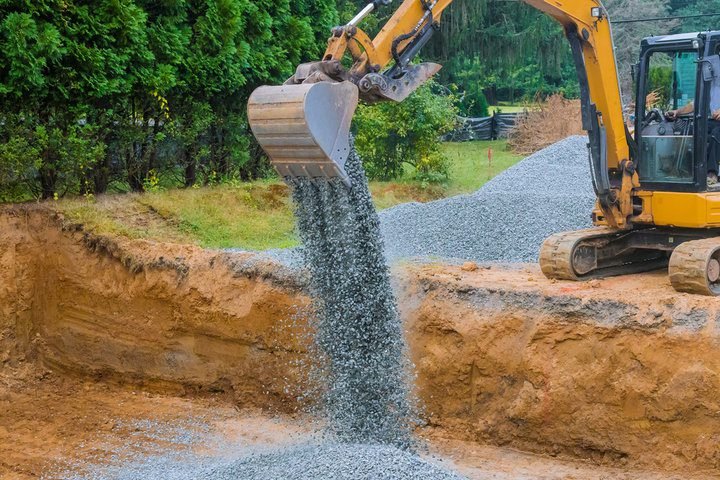
Proper prep includes stripping organic topsoil to 6 to 8 inches, proof-rolling the native subgrade to locate soft spots, installing 4 to 6 inches of crushed rock base compacted in lifts, and establishing positive drainage slope before any paving. This is where Brynion adds value beyond what a paving-only contractor typically provides. Our site prep and excavation capabilities mean we handle the full scope and are accountable for the base quality that determines how long your driveway lasts. The U.S. Environmental Protection Agency also notes that impervious surfaces affect local stormwater patterns, worth considering when designing driveway drainage on larger properties.
FAQs
Does Pacific Northwest rain make asphalt a bad choice?
Not inherently — but it requires diligence. The key is sealcoating on schedule (every 3 to 5 years), filling cracks before water gets under the surface, and having the sub-base properly installed from the start. Neglected asphalt in a wet climate deteriorates faster than in a dry climate. Well-maintained asphalt with a solid base can still reach 15 or more years in Cowlitz County’s wet winters.
Can concrete crack in Pacific Northwest winters?
Yes, though Kelso and Longview have moderate freeze-thaw exposure — not the severe cycles seen at higher elevations. The main risk is moisture infiltrating existing surface pores, freezing, and expanding. Air-entrained concrete mixes are standard practice for exterior slabs in Western Washington and significantly reduce spalling risk. Avoiding deicing salts on concrete also matters — they increase moisture absorption and chemical stress on the surface.
How thick should a driveway be in Southwest Washington?
Standard residential specs call for 4-inch asphalt over a 4-to-6-inch compacted base, or a 4-inch concrete slab over the same base. Driveways that regularly handle RVs, trailers, or work trucks should upgrade to 5 to 6 inches of concrete or a 3-inch base asphalt plus 1.5-to-2-inch surface lift. Edge thickening to 6 inches at the perimeter helps resist cracking where tires climb on and off.
How long does a driveway installation take?
Sub-base excavation and preparation typically takes one to two days for a standard residential driveway. Asphalt can be placed and is driveable within one to three days after base prep. Concrete requires seven days before light vehicle use and reaches full design strength at 28 days. Total project timelines including scheduling typically run two to three weeks from contract signing to completion.
Brynion Excavation serves homeowners, general contractors, and property developers across Kelso, Longview, Vancouver, and the broader Southwest Washington region. Whether you are leaning toward asphalt or concrete, the most important factor is working with a contractor who handles the full scope from excavation to finished surface. Contact Brynion Excavation for a site evaluation and honest quote on your driveway project.